Committees ·
Auction Committee Calculation: Boli Formula and Example
Auction committee (boli/bolli) calculation with a ₹20,000 example: the formula, a full 10-month table, discount-sharing rules and a fee check.
By Weps Technology
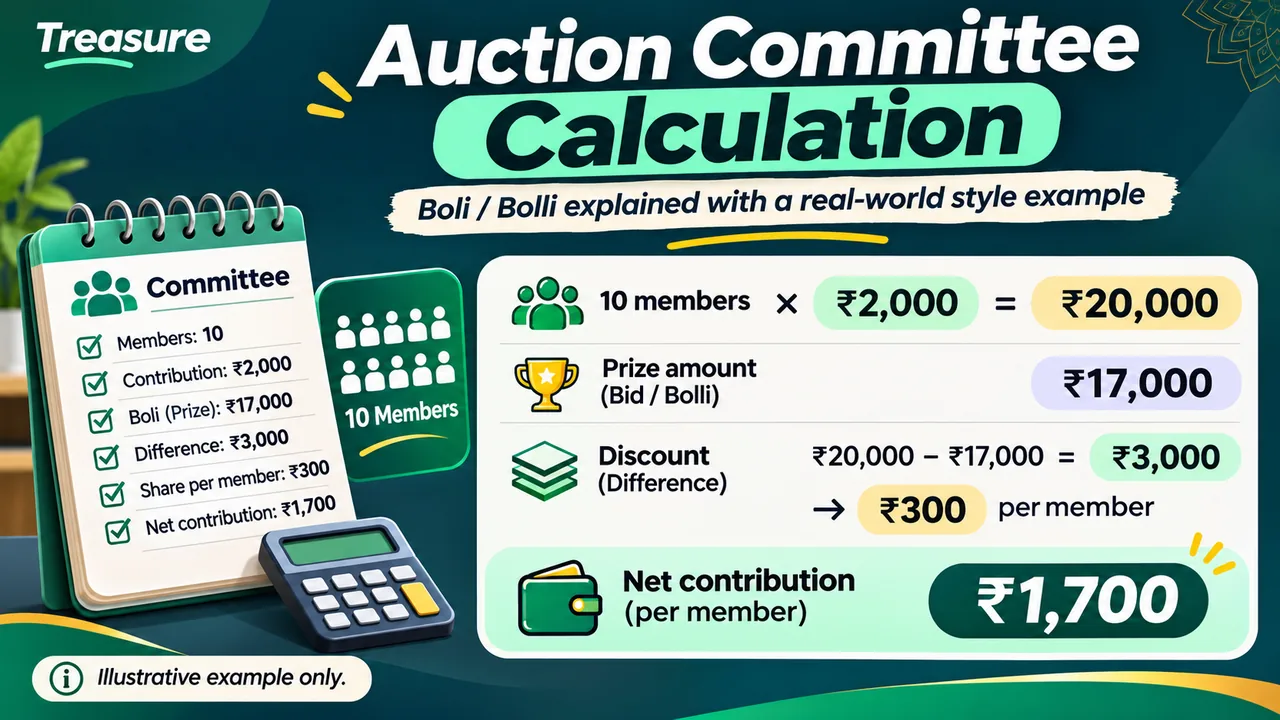
Quick answer: For a simple auction committee calculation, first find the full amount (members × standard contribution). Subtract the amount the receiving member agrees to take, the payout, to get the discount. If the whole discount is shared equally by all members and there is no fee, each member pays the standard contribution minus their share. Example: 10 × ₹2,000 = ₹20,000 full amount; ₹17,000 payout; ₹3,000 discount; ₹300 share each; ₹1,700 paid by each member. Ten payments of ₹1,700 make the ₹17,000 payout.
These are made-up teaching figures for one model: no fee, all members share. They are not a standard rate, a return or a recommendation, and this article is general education, not legal, financial or investment advice. If the basic idea of a committee is new to you, read how a committee works in India first.
Boli ka matlab: discount or payout?
Boli (also written bolli) is the auction offer a member makes for a round. The confusing part is that the number people say can mean two different things:
- Discount-style: "Boli ₹3,000" can mean the member gives up ₹3,000 from the ₹20,000 full amount and receives ₹17,000.
- Payout-style: "I will take ₹17,000" means the member receives ₹17,000, so the discount is ₹3,000.
Both describe the same round. Before calculating, ask: "Is that the amount being received, or the amount being given up?" How the winner is chosen and how the discount is shared come from your group's own terms.
The terms used in this guide
| Term | Meaning in this guide |
|---|---|
| Members | The number of people paying in a round (10 here) |
| Standard contribution | What each member is due to pay before any discount (₹2,000) |
| Full amount (gross pool) | Members × standard contribution (₹20,000) |
| Payout | What that round's receiver actually gets (₹17,000) |
| Discount | Full amount − payout (₹3,000) |
| Share | The part of the discount that goes to each member (₹300) |
| Net payment | What a member actually pays that round (₹1,700) |
The full amount is not the cash actually collected. In this model the members together pay ₹17,000 after their shares are taken off, and that ₹17,000 is what the receiver gets. Groups use different words for these terms, so check what yours means.
The formula for one round (no fee, all members share)
- Full amount = members × standard contribution
- Discount = full amount − payout
- Share per member = discount ÷ members
- Net payment per member = standard contribution − share per member
- Check: net payment × members should equal the payout
Step 5 is the useful one. If the money actually collected in a round does not equal what was handed over (plus any agreed fee), something in the calculation is wrong.
One round, worked out
All figures are made-up round numbers.
| Step | Calculation | Amount |
|---|---|---|
| Full amount | 10 × ₹2,000 | ₹20,000 |
| Payout accepted | ₹17,000 | |
| Discount | ₹20,000 − ₹17,000 | ₹3,000 |
| Share per member | ₹3,000 ÷ 10 | ₹300 |
| Net payment per member | ₹2,000 − ₹300 | ₹1,700 |
| Check | 10 × ₹1,700 | ₹17,000 |
The receiver gets ₹17,000. Every member, including the receiver, pays ₹1,700 that round.
A full 10-month example
The table below runs the same group for all 10 rounds. The payouts are invented for this example; real ones depend on who needs the amount and when. In the last month there is only one member left to receive, so there is no auction and the full amount is paid.
| Month | Payout | Discount | Share per member | Net payment per member |
|---|---|---|---|---|
| 1 | ₹16,000 | ₹4,000 | ₹400 | ₹1,600 |
| 2 | ₹16,500 | ₹3,500 | ₹350 | ₹1,650 |
| 3 | ₹17,000 | ₹3,000 | ₹300 | ₹1,700 |
| 4 | ₹17,500 | ₹2,500 | ₹250 | ₹1,750 |
| 5 | ₹18,000 | ₹2,000 | ₹200 | ₹1,800 |
| 6 | ₹18,500 | ₹1,500 | ₹150 | ₹1,850 |
| 7 | ₹19,000 | ₹1,000 | ₹100 | ₹1,900 |
| 8 | ₹19,400 | ₹600 | ₹60 | ₹1,940 |
| 9 | ₹19,700 | ₹300 | ₹30 | ₹1,970 |
| 10 | ₹20,000 | ₹0 | ₹0 | ₹2,000 |
| Total | ₹1,81,600 | ₹18,400 | ₹1,840 | ₹18,160 |
Over the 10 months, each member pays ₹18,160 in total: ₹20,000 of standard contributions minus ₹1,840 of shares. Ten members paying ₹18,160 is ₹1,81,600, which matches the total paid out.
What each member paid and received
| Member who took month | Received | Paid over 10 months | Difference |
|---|---|---|---|
| 1 | ₹16,000 | ₹18,160 | −₹2,160 |
| 2 | ₹16,500 | ₹18,160 | −₹1,660 |
| 3 | ₹17,000 | ₹18,160 | −₹1,160 |
| 4 | ₹17,500 | ₹18,160 | −₹660 |
| 5 | ₹18,000 | ₹18,160 | −₹160 |
| 6 | ₹18,500 | ₹18,160 | +₹340 |
| 7 | ₹19,000 | ₹18,160 | +₹840 |
| 8 | ₹19,400 | ₹18,160 | +₹1,240 |
| 9 | ₹19,700 | ₹18,160 | +₹1,540 |
| 10 | ₹20,000 | ₹18,160 | +₹1,840 |
Three things to read from this table:
- The differences add up to zero. No money is created. What the later members receive extra is what the earlier members gave up.
- These are plain rupee differences. They ignore the fact that month 1 and month 10 are nine months apart, and they change completely with different bids.
- Nothing here is guaranteed. The table assumes every member pays every month. It is not a return, and it should not be compared with a bank deposit or any investment.
What changes the calculation
The model above is one of several. Three common variations:
1. The discount is shared only among the other members
Some groups do not give the receiver a share. With made-up numbers: full amount ₹20,000, payout ₹17,300, discount ₹2,700.
| Step | Calculation | Amount |
|---|---|---|
| Share for each of the other 9 members | ₹2,700 ÷ 9 | ₹300 |
| Net payment by each of the 9 | ₹2,000 − ₹300 | ₹1,700 |
| Payment by the receiver | standard contribution | ₹2,000 |
| Check | 9 × ₹1,700 + ₹2,000 | ₹17,300 |
2. The group has agreed an organiser fee
Suppose the group has agreed, in writing, that a fee comes out of the discount before it is shared. With made-up numbers: payout ₹17,000, discount ₹3,000, fee ₹1,000.
| Step | Calculation | Amount |
|---|---|---|
| Left to share | ₹3,000 − ₹1,000 | ₹2,000 |
| Share per member | ₹2,000 ÷ 10 | ₹200 |
| Net payment per member | ₹2,000 − ₹200 | ₹1,800 |
| Actually collected | 10 × ₹1,800 | ₹18,000 |
| Check | ₹17,000 to receiver + ₹1,000 fee | ₹18,000 |
The ₹1,000 fee is an invented figure. It is not a usual rate, and this example says nothing about what fee is allowed.
3. Special rounds, rounding and missed payments
- In some groups the first month goes to the organiser without an auction, or a minimum or maximum discount is set. The full-cycle table then has to be redone.
- When a share does not divide evenly (₹1,000 ÷ 9, for example), the group needs a rounding rule, and the check in step 5 must include the leftover rupees.
- If a member has not paid, the table no longer matches the cash. Note the unpaid amount separately; it is not a discount.
Always calculate from the terms your own group agreed, in writing.
A note on rules and risk
Being able to do the maths says nothing about whether a group is safe or permitted. An informal committee among people who know each other and a chit fund company are not the same thing, and this article does not say which rules apply to any particular group. The guide to how a committee works has a short background on chit funds, the risks to know and the questions to ask before joining. If the legal position matters for your group, ask someone qualified.
Check your own round in seven steps
- Confirm how many members are paying and the standard contribution.
- Confirm whether the quoted boli is the discount or the payout.
- Confirm who shares the discount: all members, or everyone except the receiver.
- Confirm the fee, if any.
- Calculate each member's payment under those rules, including any rounding.
- Check that money actually collected = payout + fee.
- Write down the receiver, the date, the payout and any unpaid amount on the same day.
If step 6 does not match, ask the organiser to go through the round again before the next one.
Keeping the record
Because the payment changes every month in an auction committee, memory is not enough. For each round it helps to note the payout, the share and what each member paid.
Treasure is an Android expense tracker with an optional committees feature for keeping a committee's member list where the added members can see it; see auction committee tracking on your phone. Treasure does not calculate bids, and it does not collect, hold or send money. A record in the app is also not proof that a group is registered or permitted.
For your own records, you can add each month's payment as a transaction with a clear remark, for example "Committee, month 4, paid ₹1,750", and the amount you receive as "Committee receipt". These entries are not everyday spending, salary or profit, so read your monthly report with that in mind. The setup guide shows how to add a transaction.

Common mistakes in the calculation
- Mixing up the discount and the payout. A ₹3,000 discount and a ₹17,000 payout describe the same ₹20,000 round.
- Treating the full amount as the cash collected. In the no-fee model here, members actually pay ₹17,000 in that round, not ₹20,000.
- Dividing by the wrong number. Ten members or nine changes every member's payment.
- Forgetting the fee or the rounding. The check then fails by exactly that amount.
- Assuming this month's payment is next month's. It changes with every bid.
- Reading a later member's extra amount as a promised return. It depends on the bids and on everyone paying.
- Not writing the round down on the day. Later, nobody agrees on the bid.
Final takeaway
Full amount − payout = discount; discount ÷ members = share; standard contribution − share = what you pay. Then check that the money actually collected equals the payout, plus any agreed fee. Change the formula when the sharing rule or the fee changes, and get your group's rules in writing before the first round.
This article explains the arithmetic only. It is not legal, financial or investment advice. To keep your committee payments in one place, you can use Treasure on Google Play.
Frequently asked questions
How is an auction committee payout calculated?
In the no-fee model used in this guide, multiply members by the standard contribution to get the full amount. Subtract the amount the receiver agrees to take to get the discount. Divide the discount among the members and subtract each share from the standard contribution. Then check that the payments add up to the payout. Your group's rules may differ.
What does boli or bolli mean in a committee?
It is the auction offer a member makes for that round. Some people quote the amount they will give up (the discount) and others quote the amount they will take (the payout), so ask which number is meant before calculating.
If the full amount is ₹20,000 and the payout is ₹17,000, how much does each of 10 members pay?
If there is no fee and all ten members share the ₹3,000 discount equally, each gets ₹300 off and pays ₹1,700 that round. A different sharing rule gives a different result.
Does the receiver keep paying after getting the amount?
In the ten-round example here, yes. Every member pays in every round, including the rounds after their own turn. Your group's written terms decide what applies to you.
What happens to the calculation if a member does not pay?
The table no longer matches the real cash. Note the unpaid amount separately, check what your group's written terms say about missed payments, and do not treat the shortfall as a discount.
Does Treasure calculate auction bids or move committee money?
No. Treasure is a record-keeping app. You can keep a committee's member list in it and record your own contributions and receipt as transactions. It does not calculate bids and does not collect, hold or send money.