Committees ·
How Does a Committee (BC) Work in India? A Monthly Example
Learn how a BC or kameti works in India with a 10-member, ₹2,000 monthly example, an auction calculation, the risks to know and record-keeping tips.
By Weps Technology
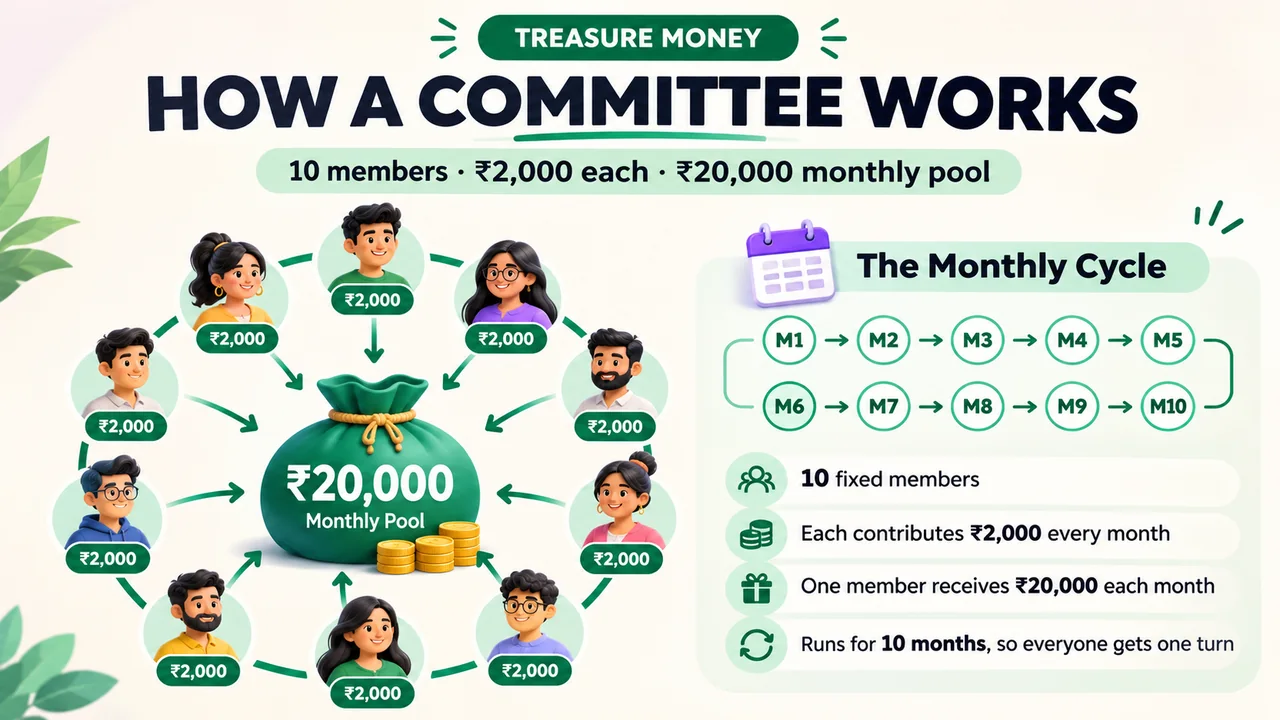
Quick answer: In a committee (also called BC or kameti), a fixed group of people each contribute the same amount at set intervals, usually monthly, and one member receives the collected amount in each round. In a simple example, 10 members paying ₹2,000 a month make a ₹20,000 monthly amount over 10 months. Each person pays in all 10 months and receives ₹20,000 once, assuming everyone pays in full and there are no fees.
This guide explains how a committee works, step by step, with one worked example. It describes the mechanics only. Rules and local names differ, and this article is general education, not legal, financial or investment advice.
Committee kya hoti hai? (BC, kameti, kitty)
In many parts of India people say committee, BC or kameti for an informal arrangement in which a group pools money and takes turns receiving it. Some groups call it a kitty, but a kitty party can also be a purely social gathering, so the word alone does not tell you how a group works. The name does not decide the rules; the group's own terms do.
Four things describe a simple committee:
- Members: a fixed list of people, agreed before the first month.
- Contribution: the amount each member pays in every round.
- Round: how often the group collects, usually once a month.
- Turn: which member receives the collected amount in a given round.
One person usually acts as the organiser. They collect the contributions, hand over the amount and keep the record. Their role, and any fee, should be written down before the first collection.
How a committee works, step by step
- The group agrees the terms. Members, contribution, due date, number of months, how turns are decided, any fee, and what happens after a missed payment.
- Every member pays the contribution each month, including members who have already received their turn.
- The receiver for the month is chosen. By an agreed order, a lucky draw, or an auction (explained below).
- The amount is handed over and recorded: who received it, how much, and on which date.
- The cycle repeats until every member has received the amount once. Then the committee ends, or the group starts a new one.
The point people often miss is step 2: receiving your turn does not end your payments. You keep contributing until the last month.
A monthly example: 10 members, ₹2,000 each
The figures below are made-up round numbers to explain the method. They are not typical amounts for any city or group, and they assume every member pays in full, with no fees.
| Detail | Simple fixed-turn example |
|---|---|
| Members | 10 |
| Contribution per member per month | ₹2,000 |
| Collected each month | 10 × ₹2,000 = ₹20,000 |
| Number of monthly rounds | 10 |
| Paid by each member over the full cycle | 10 × ₹2,000 = ₹20,000 |
| Received by each member, once | ₹20,000 |
Month-by-month schedule
| Month | Collected from all members | Who receives it | Amount received |
|---|---|---|---|
| 1 | ₹20,000 | Member 1 | ₹20,000 |
| 2 | ₹20,000 | Member 2 | ₹20,000 |
| 3 | ₹20,000 | Member 3 | ₹20,000 |
| 4 | ₹20,000 | Member 4 | ₹20,000 |
| 5 | ₹20,000 | Member 5 | ₹20,000 |
| 6 | ₹20,000 | Member 6 | ₹20,000 |
| 7 | ₹20,000 | Member 7 | ₹20,000 |
| 8 | ₹20,000 | Member 8 | ₹20,000 |
| 9 | ₹20,000 | Member 9 | ₹20,000 |
| 10 | ₹20,000 | Member 10 | ₹20,000 |
Across the 10 rounds the group collects ₹2,00,000 and hands over ₹2,00,000. In this example every member puts in ₹20,000 and receives ₹20,000. What differs is timing, not gain: Member 1 gets the amount in the first month and still owes nine more contributions, while Member 10 pays for ten months and receives the amount at the end.
Fixed-turn committee vs auction (bolli) committee
There are two common ways to decide who receives the amount.
| Fixed turn or lucky draw | Auction or bolli | |
|---|---|---|
| How the receiver is chosen | An agreed order, or a draw | Members bid under the group's rules |
| Amount received | The full collected amount, in the simple example | Can be less than the collected amount |
| The difference | None | Shared or used according to the group's rules |
| What to check | That everyone keeps paying after their turn | Bid rules, fees and how the difference is shared |
An auction round, with made-up numbers
Using the same group, suppose that in one month a member agrees to take ₹17,000 instead of the full ₹20,000.
| Step | Amount |
|---|---|
| Collected amount for the month | ₹20,000 |
| Lowest bid: a member agrees to take | ₹17,000 |
| Difference | ₹3,000 |
| If the whole difference is shared equally among 10 members (₹3,000 ÷ 10) | ₹300 each |
| What each member then pays that month (₹2,000 − ₹300) | ₹1,700 |
| Paid by 10 members (10 × ₹1,700) | ₹17,000 |
This is one simple model, not a standard rule. Some groups share the difference among all members, some only among the others, and some set aside a fee for the organiser. The first or last month may also follow a separate rule. Always calculate from the terms your own group agreed. For the full maths, including a 10-month table, see auction committee calculation, step by step.
Committees and chit funds: the legal background in brief
An informal committee among people who know each other and a chit fund company are not the same thing, even though the idea of rotating a pooled amount is similar.
Chit fund companies in India come under the Chit Funds Act, 1982. The Reserve Bank of India's public FAQ on non-banking financial companies explains that this is a central law implemented by the state governments, and that chit fund companies are registered and regulated by the state government, not by the Reserve Bank. You can read it in the RBI FAQ on NBFCs (see the section on chit funds).
This article does not say whether any particular group is covered by that law, registered, or permitted. That depends on how the group is actually set up and on the rules where you live. If that question matters for your group, ask someone qualified.
What can go wrong, and what to ask before you join
A committee depends on every member paying every month and on the organiser handing over the amount as agreed. Things that commonly cause trouble:
- A member stops paying after receiving an early turn.
- The organiser delays or does not hand over the amount.
- Members disagree about an auction or how the difference was shared.
- The record is incomplete, so nobody can show who paid.
A written record helps with the last one. It does not guarantee that anyone will pay. Before joining, it is worth asking:
- Who collects the money, and who holds it between collection and handover?
- Are the terms, any fee and each member's obligations written down?
- How will each payment and each handover be confirmed?
- What happens if a member misses a payment, or stops after their turn?
- If the group calls itself a chit fund, can its registration be checked with the state authority?
What every member should have in writing
Most committee disagreements are about memory, not maths. Before the first month, it helps if every member has the same short record:
- The member list, with phone numbers shared only with the members' agreement.
- The contribution amount and the date it is due each month.
- How turns are decided, and for an auction, how the difference is shared.
- The organiser's role, and any fee.
- What the group will do about a late or missed payment.
- A month-by-month record: who paid, who received, and on which date.
A notebook can hold this. The weakness of a notebook, or a WhatsApp thread, is that only one person has the current version.
Keeping the record on your phone
There are two separate records worth keeping, and it is cleaner not to mix them.
The group's record. Treasure is an Android expense tracker with an optional committees feature: you can create a committee, add members with contact details, and the members you add can view that committee in the app. Treasure only keeps the record. It does not collect, hold or send money, and it is not a bank or a chit fund. Read more in auction committee tracking on your phone.
Your own record. Your contribution is money going out of your pocket each month, and your turn is money coming in. It helps to note both, with one caution: the amount you receive is not salary or profit. In the simple example it is your own ₹20,000 coming back at a different time. In the same way, a contribution is not money spent on something; it is money set aside in the group.
If you record these as transactions:
- Add each contribution with a clear remark, such as "Committee contribution, month 4".
- Add the amount you receive with a remark such as "Committee receipt".
- When you read your monthly report, remember that these entries make your expense look higher in most months and your income look higher in the month of your turn.

If you are new to tracking, start with how to track income and expenses on Android, or see the Treasure setup guide.
Common mistakes in a committee
- No written terms. Everyone remembers the auction rule slightly differently by month six.
- Stopping payments in your head after your turn. You still owe every remaining month.
- Assuming the auction difference is always shared equally. Read your group's rule.
- Treating the amount you receive as profit. In the simple model it is your own money returning.
- Only the organiser has the list. If their phone or notebook is unavailable, nobody can check.
- Not noting the date of each payment. "Paid" without a date is hard to confirm later.
Final takeaway
A committee is a fixed group, a fixed contribution and one receiver per round, repeated until everyone has had a turn. In a fixed-turn committee each member pays and receives the same total, and only the timing differs. In an auction committee, a member can take the amount early by accepting less, and the group shares the difference by its own rules.
Whichever type you join, check the written terms and the organiser, and keep a month-by-month record that every member can see. This article is general education, not legal, financial or investment advice.
To keep a committee's member list and your own contributions in one place, you can use Treasure on Google Play.
Frequently asked questions
What is a committee, BC or kameti?
It is a group arrangement in which members contribute a fixed amount at regular intervals, usually monthly, and one member receives the collected amount in each round. The exact rules differ from group to group, especially in auction-style groups.
How long does a 10-member committee run?
In a simple model with monthly rounds and one turn per member, it runs for 10 months. Actual length depends on what the group agreed.
Do I keep paying after I receive my turn?
Yes. In the example in this guide every member contributes in all 10 months, including the months after they have received the amount.
How does an auction (bolli) committee work?
Members who want the amount in a given round bid for it, and the member who accepts the lowest amount takes that round. How the difference is shared, and any organiser fee, depend on the group's own rules.
Is the amount I receive from a committee income?
Not in the usual sense. In the simple example you receive back the same total you contribute, so it is your own money returning at a different time, not salary or profit. Label it clearly in your records so your reports are not misread.
Does Treasure collect or pay committee money?
No. Treasure is a record-keeping app. It does not collect, hold or send money. You can keep a committee's member list in it and record your own contributions as transactions.